Cheap woven labels refer to affordable woven labels that meet basic brand promotion and recognition needs while maintaining a certain level of durability. For some startups, fast fashion brands, and promotional apparel manufacturers, cost control is crucial, making personalized and affordable custom woven labels their preferred choice.
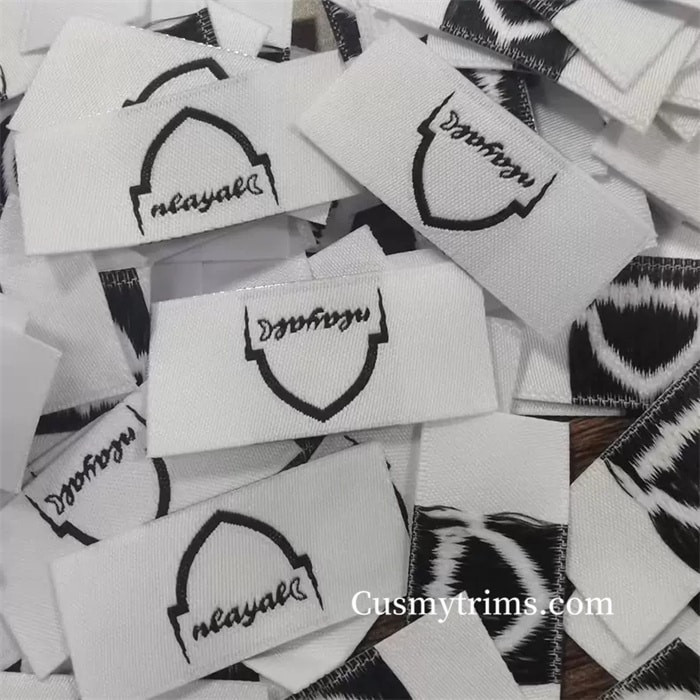
We are a professional woven label manufacturer and supplier in China, providing exclusive, customized, and affordable woven labels for apparel brands. These labels have low minimum order quantities and are inexpensive. In addition, you can customize any size, shape, color, type,ect. These inexpensive garment woven labels are suitable not only for various garments but also for brands of bags, gloves, home textiles, handicrafts, and more.
So, how can you customize personalized and affordable woven labels for your brand? Below, we’ll answer these questions one by one, covering aspects such as materials, types, sizes, colors, and folding methods for custom woven labels, hoping to help you. If you have any ideas or creative suggestions for customizing cheap woven labels, please feel free to contact us. Affordable prices, beautiful designs, we look forward to your patronage!
The most common materials for inexpensive woven labels are polyester, polyester blends, and recycled polyester.
Polyester is the cheapest. This material is strong, not easily broken, washable, abrasion-resistant, and has high colorfastness, making it suitable for mass production and the most common and economical choice. However, polyester has a slightly stiffer surface and is not as smooth as high-end materials. It is suitable for basic clothing and promotional garments.
Recycled polyester fabric adds environmental benefits while remaining inexpensive. Its appearance is similar to regular polyester, and its cost is slightly higher but cheaper than cotton or satin. It is suitable for brands with limited budgets but a focus on environmental protection, helping to enhance brand image.
Polyester blends refer to fabrics with polyester as the main component, while adding other fibers such as cotton, nylon, and rayon in certain proportions to improve performance and control costs. Compared to pure polyester, blends offer reduced stiffness, improved skin-friendliness, and increased washability, tensile strength, and pill resistance.
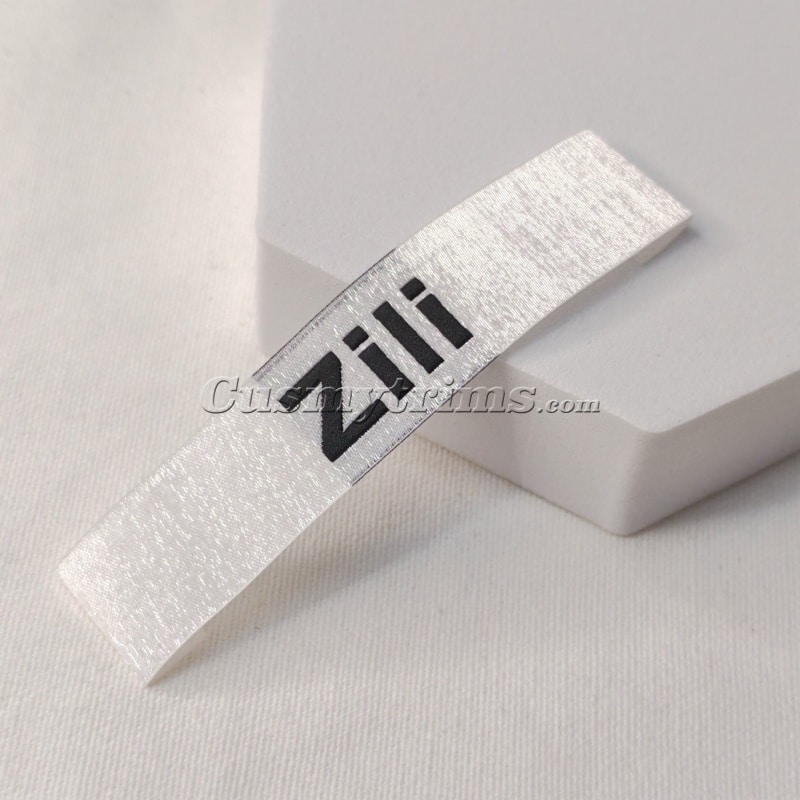
Satin fabric has a smooth, glossy surface and a lightweight, delicate feel, but its cost is higher than that of polyester. If you have high requirements for the comfort of the woven label, you can choose a satin woven label.
Whether it’s woven size labels, brand labels, or care labels, the more complex the manufacturing process and the more content, the more expensive the woven label. Cheap woven labels don’t pursue complex designs or high-end textures. They prioritize clear identification, durability, ease of mass production, and lower unit prices, all while keeping costs under control and simplifying the manufacturing process.
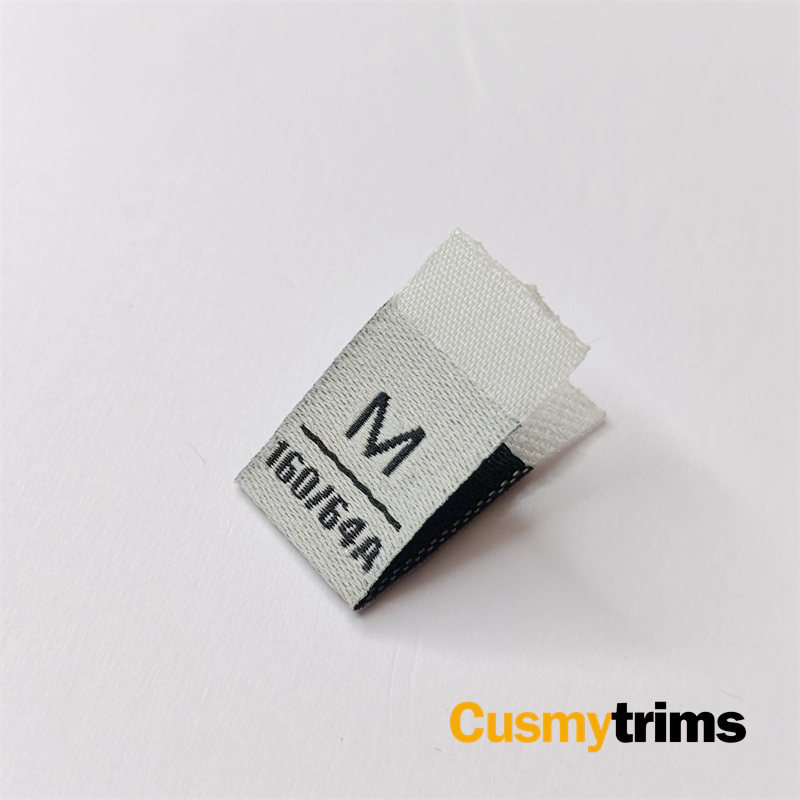
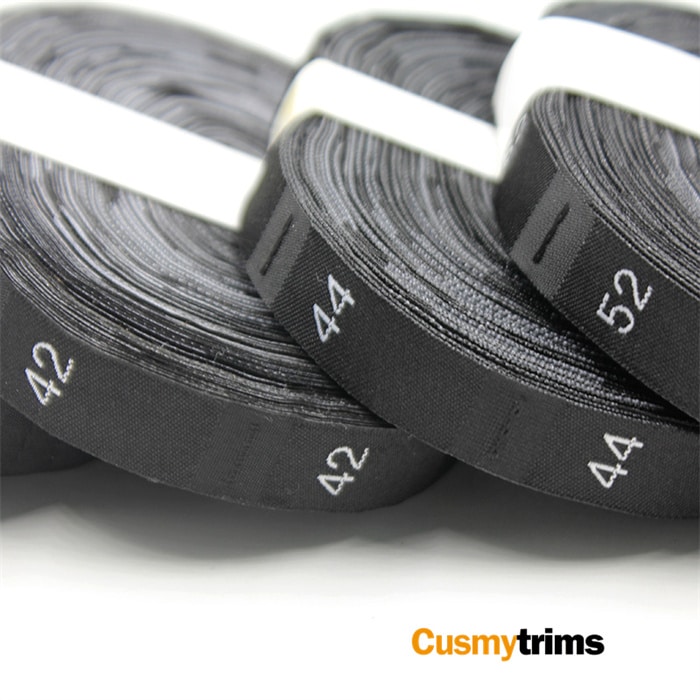
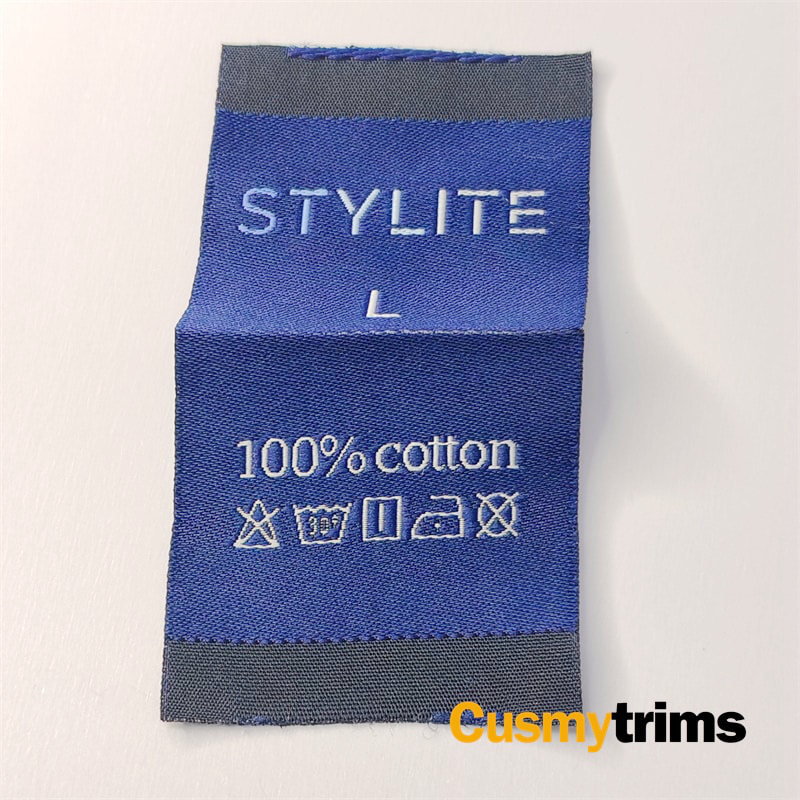
For example, the most typical and widely used woven size label only indicates simple letter or number sizes for easy consumer identification; the brand label only displays the brand name or a simplified logo, providing basic brand recognition and avoiding high-density details; and the care label provides basic washing symbols or brief text instructions.
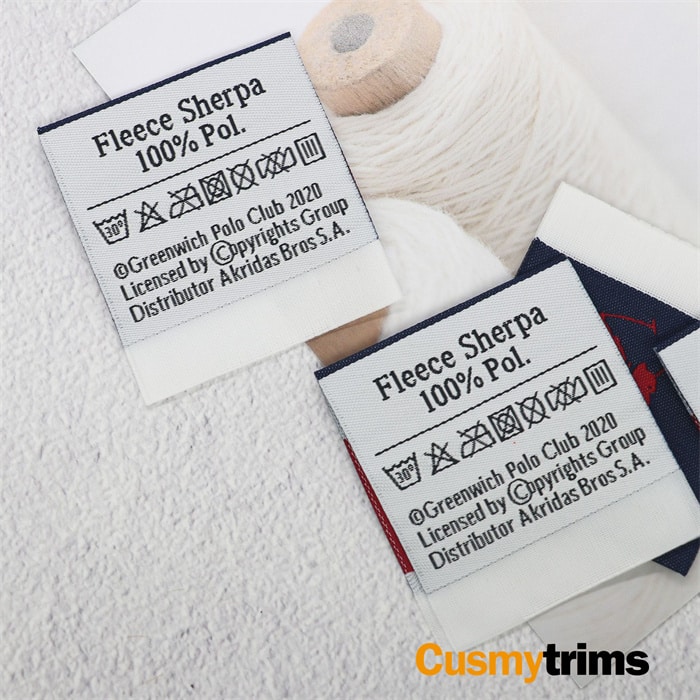
Woven labels are divided into damask woven labels, satin woven labels, and crocheted woven labels. Damask woven labels, woven on computerized machines, offer high production efficiency, short production cycles, and a wider range of colors, making them the most affordable and popular choice for custom-made labels.
If you want to further control costs, you can choose plain weave brocade labels. They have a simple structure, use less yarn, and have high production capacity. While the surface is smooth, the layering is weak, making them unsuitable for high-precision logos. Alternatively, you can choose low-density damask labels, which reduce yarn usage by lowering the weaving density. They offer more three-dimensionality than plain weave labels and clearly display the brand name and logo, but the pattern contrast is lower than high-density damask labels, making them unsuitable for fine lines and complex patterns.
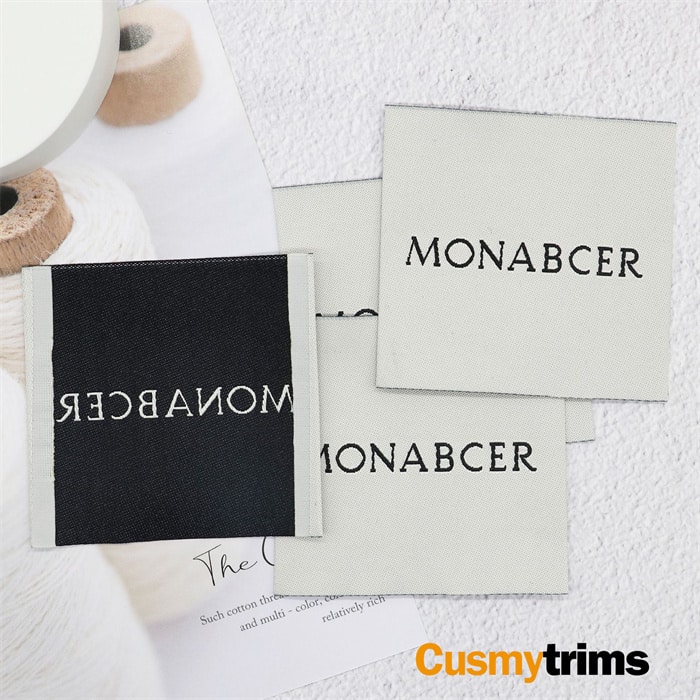

If you have a limited budget but still want softness, you can choose satin woven labels. They have a smooth, glossy surface, a soft feel, and are comfortable against the skin, making them suitable for labels that come into direct contact with the skin. However, the floats are longer, making them less abrasion-resistant than brocade woven labels, and they are more suitable for simple logos and text designs.
Crochet labels, due to their high density and lower production efficiency, are more expensive than brocade and satin woven labels. However, they have a more three-dimensional and handcrafted feel, a delicate and soft appearance, a comfortable and thick touch, and are more durable.
For inexpensive woven labels, a well-designed size can reduce yarn consumption, weaving time, and post-processing costs while ensuring basic legibility. First, the label size only needs to ensure the information is clearly legible; no extra white space is required. Smaller sizes use less yarn and have a lower unit price. Second, try to choose fixed standard sizes, as this reduces machine setup and sampling costs and facilitates mass production and subsequent repeat orders.
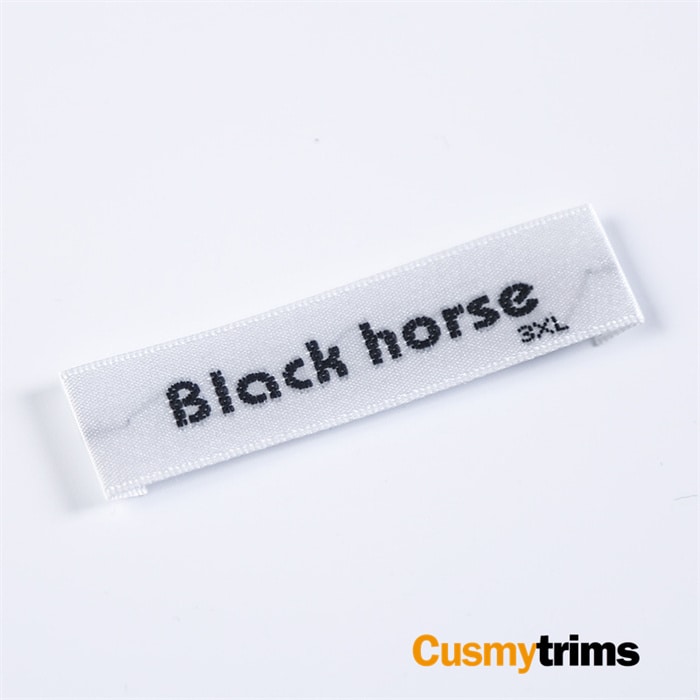
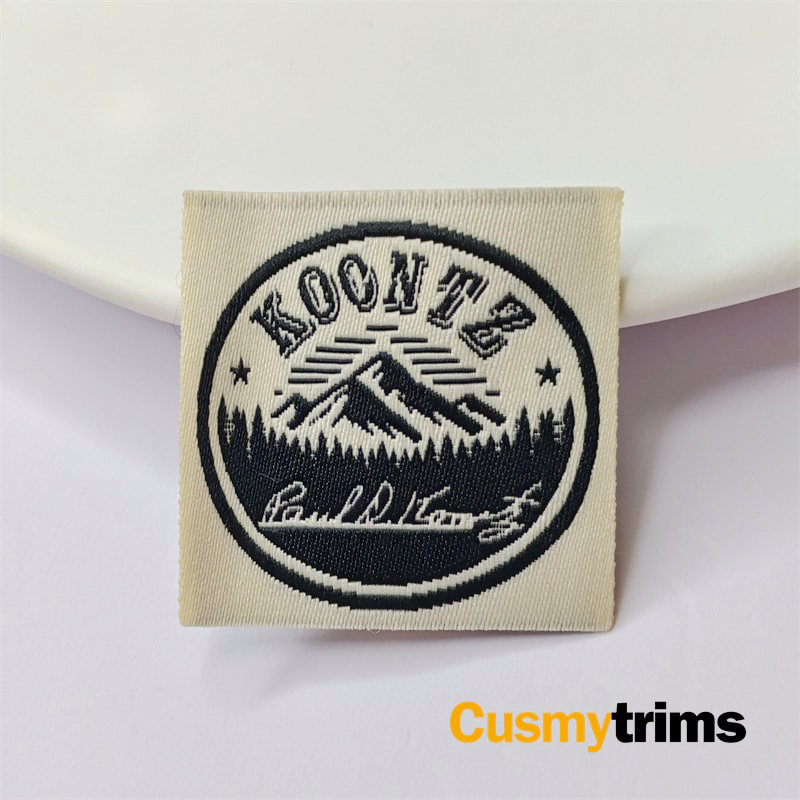
For inexpensive woven labels, controlling the number and color scheme of colors can save costs.
First, fewer colors mean lower costs, while more colors mean higher prices. To control costs, it’s recommended to choose one or two colors per label.
Second, you can enhance the texture through contrasting shades of color, rather than simply piling on colors. Simple color contrasts are more visually appealing and practical than complex color schemes.
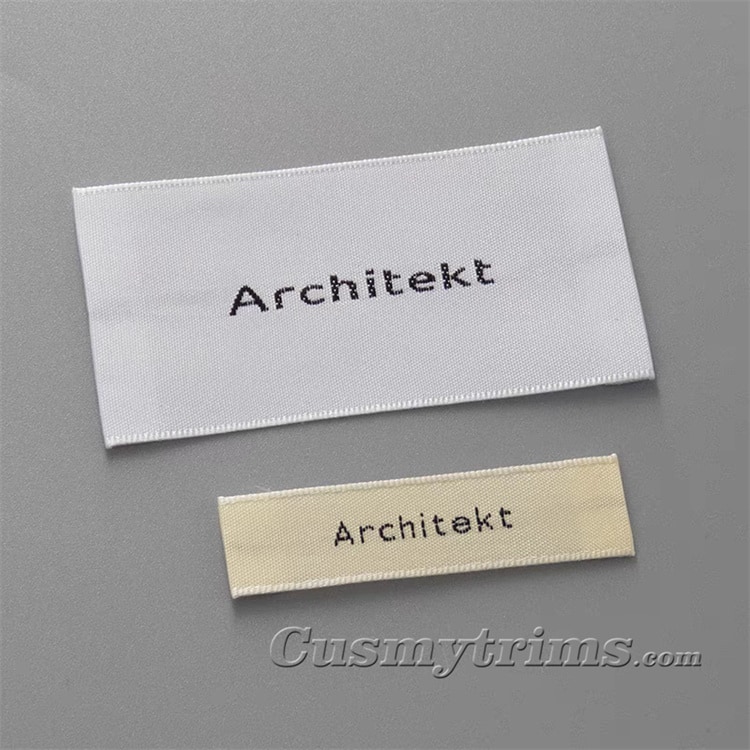

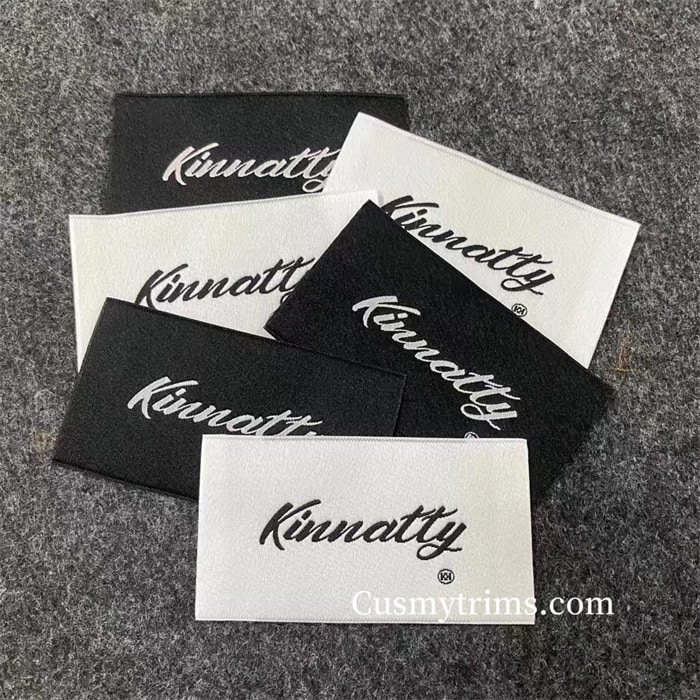
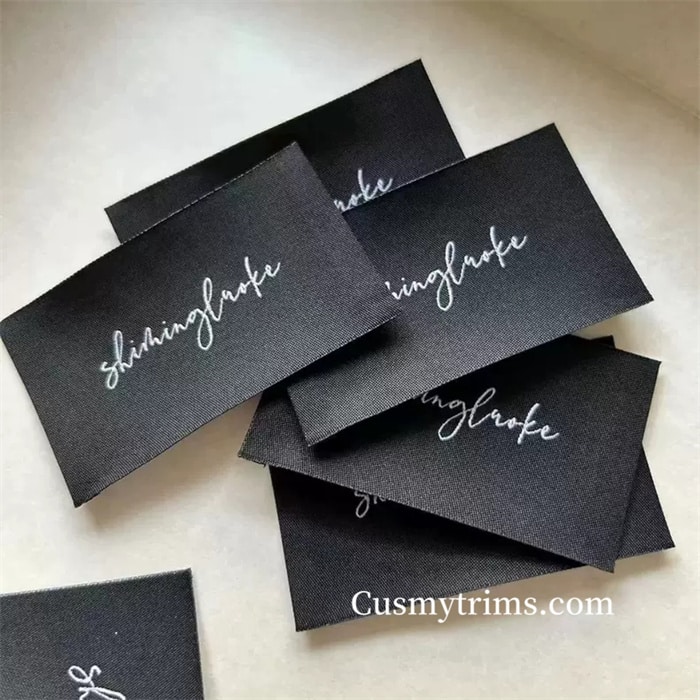
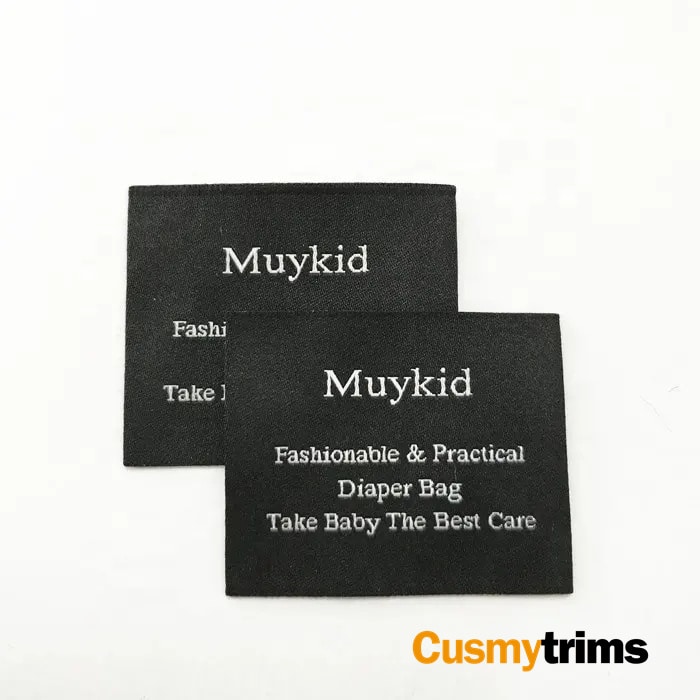
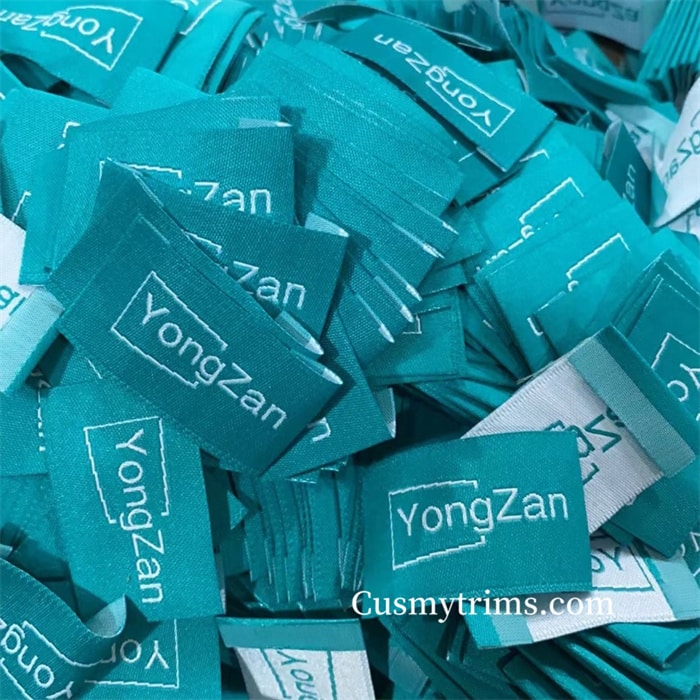
Furthermore, choosing standard stock colors instead of custom dyeing will increase the minimum order quantity and yarn cost, while standard black, white, and beige colors can save costs. For example, a black background with a white logo or text, or a white background with a black logo or text, is not only low-cost but also highly recognizable.
In short, when budgets are limited, simple color schemes are more professional, more visually appealing, and more conducive to long-term repeat orders and large-scale production.
Among the many folding methods, the straight cut is the simplest and cheapest, requiring the fewest steps and offering the highest efficiency. Straight cuts are further divided into laser cutting and heat cutting. Heat cutting is cheaper than laser cutting, using high temperatures to cut the yarn, preventing fraying, but resulting in stiffer edges on the woven label. Laser cutting, on the other hand, uses an ultrasonic cutter, producing softer edges, and is currently the most commonly used cost-effective cutting method.
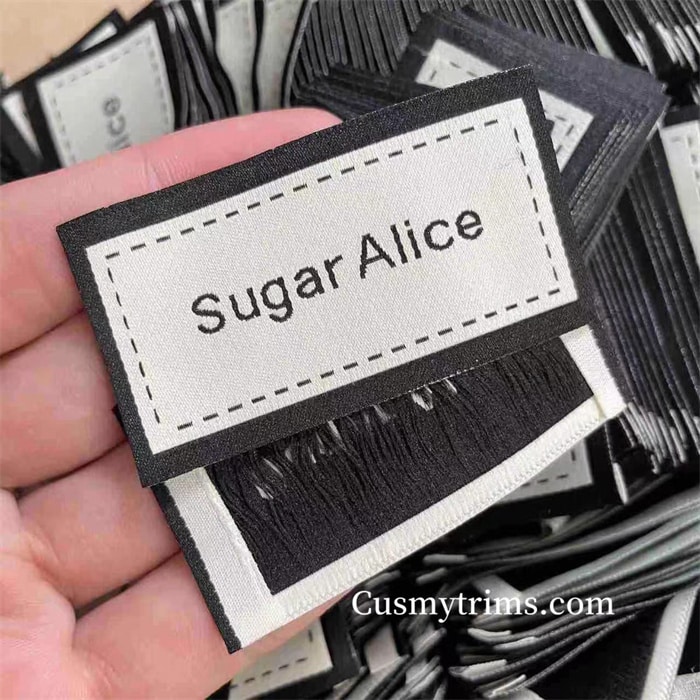
Besides straight cuts, you can also choose a center fold, balancing cost and practicality. Fold the label in half and sew it in, tucking the ends into the seam. This looks neater than a straight cut but is slightly more expensive and is commonly used for neck labels. Alternatively, you can choose an end fold for even neater results, folding the ends of the woven label inwards for greater overall stability.

Increasing order quantity is one of the most direct and effective ways to reduce unit costs when customizing woven labels. Larger-scale production spreads fixed costs, improves production efficiency, and reduces unit waste. Therefore, the more woven labels you customize, the lower the unit price.
Firstly, a large minimum order quantity spreads out the start-up and sampling costs significantly, resulting in a substantial decrease in unit price as the quantity increases. Furthermore, continuous production of uniform specifications reduces downtime for pattern changes, stabilizes weaving speed, and simultaneously reduces labor and time costs. This is suitable for long-term cooperation and rolling replenishment orders.
Secondly, centralized ordering reduces the need for splitting orders and allows for planning of annual or quarterly usage. Even with partial deliveries, pricing can be negotiated based on the total quantity, avoiding multiple production runs of small orders and reducing costs. Consolidation, standardization, and planning are more important than simply “buying more.”
When customizing woven labels, new customers generally pay higher prices than existing customers. Therefore, choosing a high-quality supplier as a regular partner and establishing a long-term cooperative relationship is crucial.
This not only ensures stable machine models and processes during customization, reducing redundant confirmations and testing, guaranteeing consistent quality and avoiding errors, but also allows for discounted pricing on subsequent orders, saving costs. This is a common method used by woven label manufacturers and suppliers to attract repeat customers.




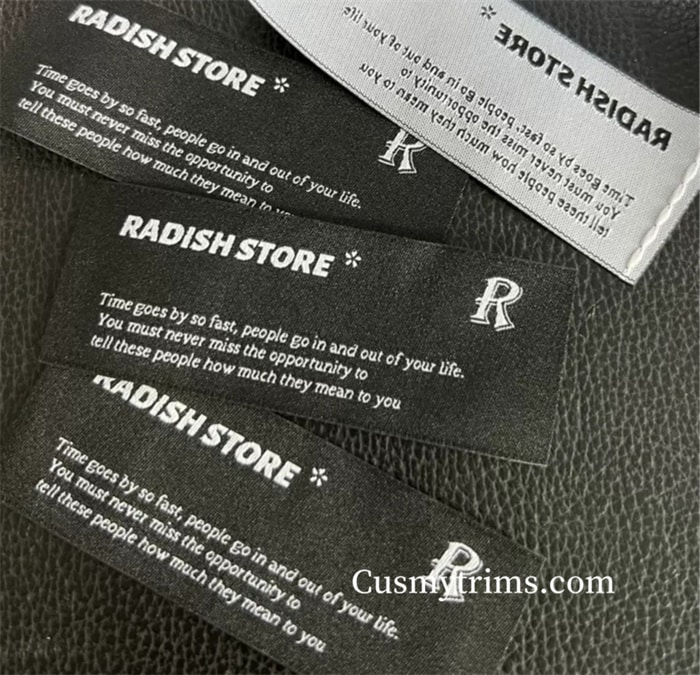

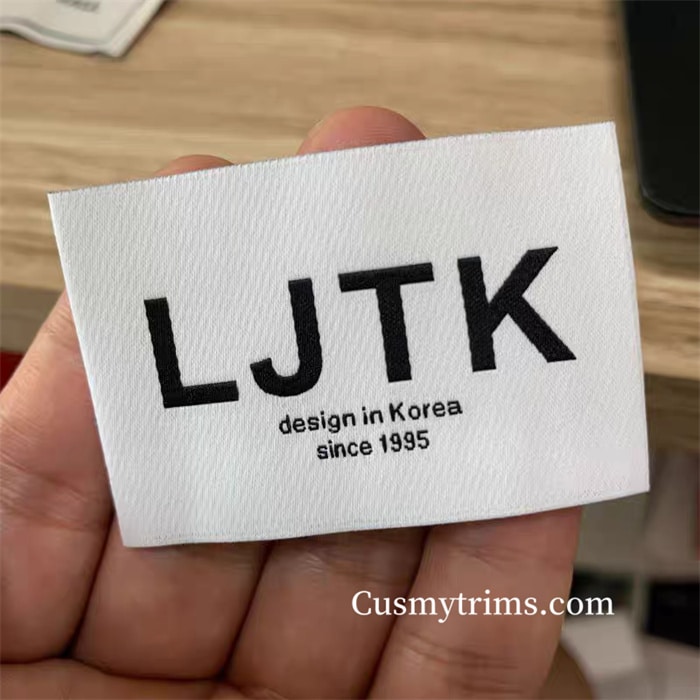
You can send us vector logo files, like PDF, AI, ESP, CDR, or original files from PSD. If you have no art file, we supply a free design for you.
Bulk production time is 15 to 20 days. Shipping time 5-7 days by FedEx or DHL; 7-10 days by air freight; 30-40 days by sea.
1. by Paypal; 2. by Bank Transfer(T/T);
The price is determined by your logos, size, color, materials, shapes, techniques, or order quantity. So, the prices are not fixed. After you tell us your specific needs, our sales manager will calculate the final price for you. You can request a free quote and send your art files to us. We make free designs for you.
Step 1. Contact us and tell us your artwork, materials, size, colors, techniques, destination, etc. If you have no ideas, please attach our similar product pictures.
Step 2. Once receive your details, we’ll reply to you ASAP. And quote you the price, the freight charge, and the transfer charge;
Step 3. After you confirm the price, we will issue the invoice.
Step 4. We will make designs if you don’t have a design file after receiving your payment.
Step 5. If you prefer to make samples first. We will proceed with the samples after receiving your sample charge. If not, please skip step 6.
Step 6. After receiving your design or sample approval. We will start producing the bulk goods.
Step 7. Bulk production and inspection, and handover of the goods;
Step 8. After-sales service;